
Introduction
For nearly two decades, Google has dominated the digital advertising industry. Whenever marketers discussed online advertising, Google Search Ads were the default choice. But 2026 may become the year that changes everything.
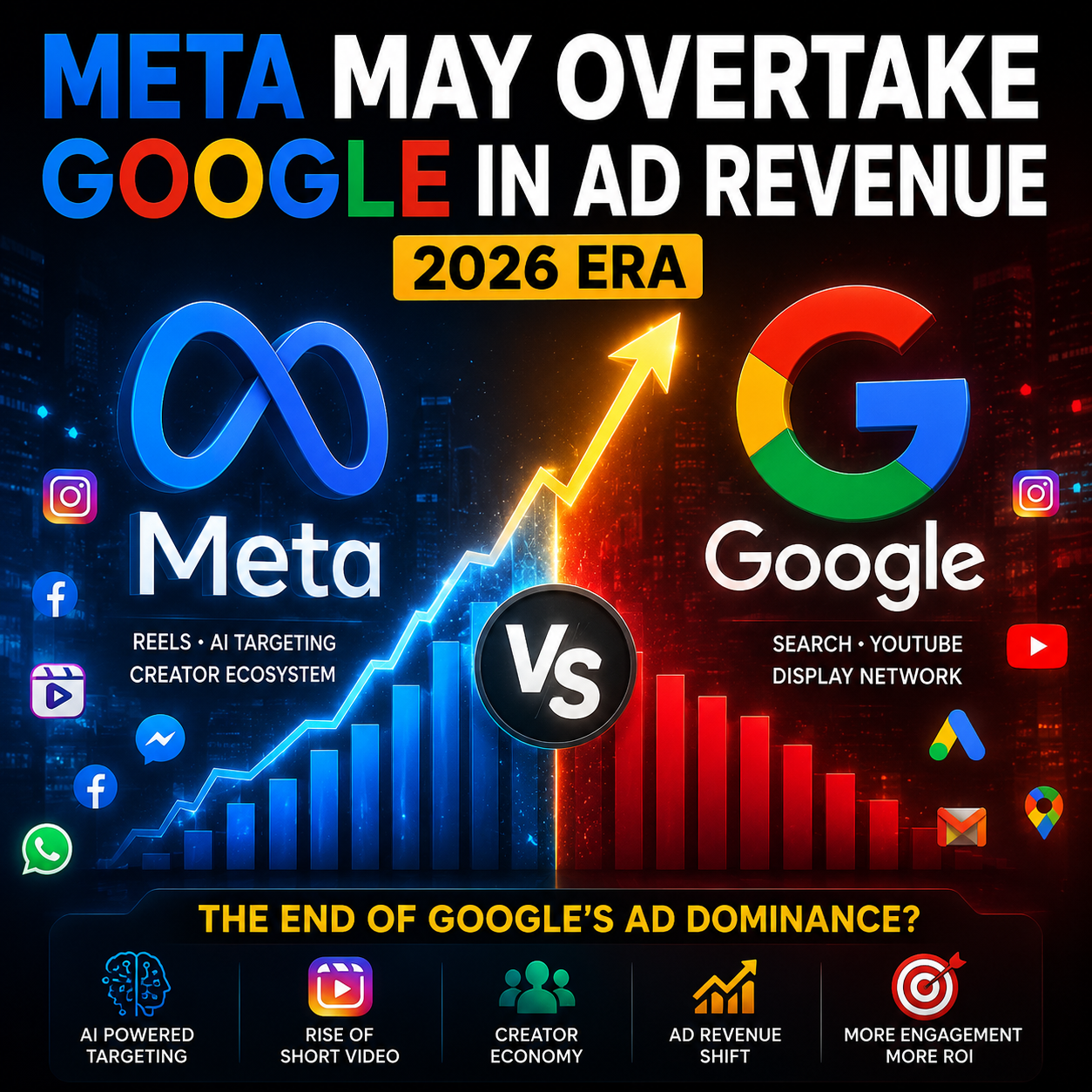
According to recent forecasts from eMarketer, Meta is projected to generate approximately $243.46 billion in global digital advertising revenue, slightly surpassing Google’s expected $239.54 billion. If this prediction becomes reality, it will mark the first time Google loses its position as the world’s largest digital advertising company.
For marketers, agency owners, and business leaders, this isn’t just another industry statistic. It signals a fundamental shift in how consumers discover products, engage with brands, and make purchasing decisions.
The rise of AI-powered advertising, short-form video dominance, and advanced targeting capabilities visible through tools like the ad meta library are transforming the advertising landscape faster than ever before.
So what is driving this historic shift, and what does it mean for the future of digital marketing?
Suggested Featured Image


5
Image Caption: Meta and Google continue to battle for dominance in the global digital advertising market.
The Numbers Behind the Prediction
Recent industry forecasts reveal a dramatic change in market dynamics.
| Metric (2026 Forecast) | Meta | |
|---|---|---|
| Ad Revenue | $243.46 Billion | $239.54 Billion |
| Growth Rate | 24.1% | 11.9% |
| Global Market Share | 26.8% | 26.4% |
| Main Growth Driver | AI Advertising & Reels | Search & YouTube |
Source: eMarketer, Reuters
What’s particularly interesting isn’t the revenue difference itself. The real story is Meta’s growth rate.
Meta is growing at more than double Google’s projected advertising growth rate, allowing it to close an $18 billion gap in just one year.
Why Meta Is Growing Faster Than Google
1. AI Has Changed Advertising Forever
One of the biggest reasons behind Meta’s growth is its aggressive investment in AI-powered advertising.
The company has heavily promoted its Advantage+ advertising system, which automates:
- Audience targeting
- Creative optimization
- Budget allocation
- Campaign testing
- Conversion prediction
Instead of advertisers manually controlling every setting, Meta’s AI increasingly handles optimization automatically.
This reduces complexity while improving campaign performance for businesses of all sizes.
Personal Observation
As someone working closely with digital marketing campaigns, I’ve noticed a major shift over the last two years.
Previously, campaign success depended heavily on audience research and manual optimization.
Today, Meta’s machine learning often identifies profitable audiences faster than experienced media buyers.
This doesn’t eliminate the need for strategy—it changes where marketers should focus their effort.
2. Reels Has Become a Revenue Machine
Many marketers initially viewed Instagram Reels as merely a TikTok competitor.
That assumption turned out to be wrong.
Reels has evolved into one of Meta’s strongest engagement and advertising channels.
Consumers increasingly spend time consuming:
- Short-form videos
- Product reviews
- Creator content
- Educational clips
- Entertainment reels
Advertisers naturally follow attention.
As attention shifts from traditional search behavior toward discovery-based content consumption, Meta gains a significant advantage.
3. New Ad Placements Are Expanding Inventory
Meta’s ecosystem now extends beyond Facebook and Instagram.
The company continues expanding advertising opportunities across:
- Threads
- Messenger
- Reels
- Facebook Marketplace
More inventory means more opportunities to generate revenue while keeping advertiser demand strong.
The Hidden Power of the Ad Meta Library
What Is the Ad Meta Library?
The ad meta library is one of the most valuable free marketing research tools available today.
Official Resource:
It allows users to:
- View active advertisements
- Analyze competitors
- Study creative trends
- Monitor brand campaigns
- Discover winning ad angles
Unlike traditional advertising platforms, Meta offers remarkable transparency into advertiser activity.
Why Smart Marketers Use the Ad Meta Library Daily
The most successful advertisers don’t guess.
They research.
Using the ad meta library, marketers can:
Discover Winning Creatives
Observe which advertisements have been running for months.
Long-running ads often indicate profitability.
Analyze Competitor Messaging
Study:
- Headlines
- Offers
- Hooks
- CTAs
- Landing page strategies
Identify Market Trends
Notice recurring themes across industries.
Patterns often reveal where consumer attention is moving.
Why Google Is Facing New Challenges
Google remains a giant.
However, its traditional strengths are facing pressure from multiple directions.
Search Behavior Is Changing
For years, consumers searched for information directly through Google.
Now users increasingly discover products through:
- TikTok
- YouTube Shorts
- AI assistants
This shift reduces Google’s exclusive control over digital discovery.
AI Search Is Reshaping Traffic
Google’s introduction of AI-generated search summaries creates new opportunities but also new risks.
As AI answers become more prominent, traditional website traffic patterns may change significantly.
Publishers, advertisers, and SEO professionals are closely watching how this transformation impacts user behavior.
Meta vs Google: Which Platform Delivers Better ROI?
The answer depends on business goals.
| Goal | Better Platform |
|---|---|
| High Purchase Intent | Google Ads |
| Brand Awareness | Meta Ads |
| Product Discovery | Meta Ads |
| Lead Generation | Both |
| Local Business Searches | Google Ads |
| Viral Growth | Meta Ads |
| Visual Products | Meta Ads |
| Search Demand Capture | Google Ads |
The future isn’t Meta versus Google.
The future is understanding how each platform fits into the customer journey.
What This Means for Businesses in 2026
Businesses should prepare for several major shifts.
Expect More AI Automation
Campaign management will become increasingly automated.
Human marketers will focus more on:
- Strategy
- Creative direction
- Customer psychology
- Brand positioning
Creative Will Matter More Than Targeting
As targeting becomes automated, creative quality becomes the biggest competitive advantage.
Winning advertisers will invest heavily in:
- Video content
- Storytelling
- Creator partnerships
- UGC content
Competitive Research Will Become Essential
Tools like the ad meta library will become critical intelligence platforms.
Businesses that consistently monitor competitors will adapt faster and discover opportunities earlier.
Key Takeaways
✅ Meta is projected to surpass Google in global ad revenue for the first time in 2026.
✅ Forecasted revenue stands at approximately $243.46 billion for Meta versus $239.54 billion for Google.
✅ AI-powered advertising through Advantage+ is a major growth catalyst.
✅ Reels, WhatsApp, and Threads continue expanding Meta’s advertising ecosystem.
✅ The ad meta library provides invaluable competitor research and creative inspiration.
✅ Google remains dominant in search intent advertising but faces increasing competition from social discovery platforms.
Conclusion
The prediction that Meta may overtake Google in ad revenue isn’t merely about numbers.
It’s evidence of a larger transformation happening across the internet.
Consumers are spending less time searching and more time discovering.
AI is reducing the importance of manual campaign management.
Creative storytelling is becoming more valuable than technical optimization.
For marketers and businesses, the lesson is clear:
Don’t focus on who wins the battle between Meta and Google.
Focus on understanding where consumer attention is moving.
Those who adapt fastest will capture the greatest opportunities in the next era of digital advertising.






nice